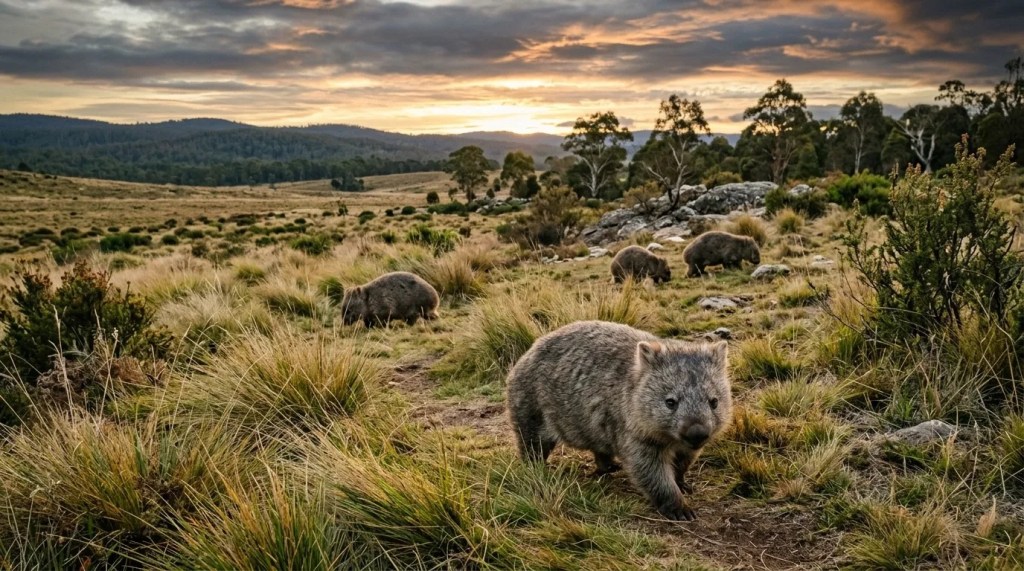
Wombats may look like slow, chunky “forest teddy bears,” but Wombat are actually some of the most unusual and misunderstood mammals in Australia. Beneath their calm appearance is a body built for digging, survival, and some surprisingly clever defense tactics.
Let’s break down the facts, myths, and hidden truths about these fascinating marsupials.
What exactly is a wombat?
Wombats are burrowing marsupials native to Australia. That means they carry and nurse their young in a pouch, like kangaroos and koalas.
They belong to a very small group of animals adapted for underground life, spending much of their time in complex tunnel systems called burrows.
There are three main species:
Common wombat Northern hairy-nosed wombat (critically endangered) Southern hairy-nosed wombat
Built like a tank (literally)
Wombats are often called “nature’s bulldozers” for good reason:
Their bodies are low, heavy, and extremely strong They have thick cartilage at the rear (almost like a shield) This helps them block predators inside tunnels
One of their most famous traits:
If threatened, a wombat can use its rear end to block a tunnel entrance, making it nearly impossible for predators to pull them out.
The cube-shaped mystery
One of the strangest facts in the animal kingdom:
Wombats produce cube-shaped poop
Scientists believe this helps the droppings stack neatly to mark territory without rolling away.
This unusual feature is caused by the unique elasticity in their intestines, which shapes the waste as it forms.
Nocturnal lifestyle
Wombats are mostly active at night:
They avoid the hot Australian daytime heat They spend nights digging, feeding, and exploring They sleep in burrows during the day
Their diet is simple but tough:
Grass Roots Bark
They can survive on very low-nutrient food thanks to a slow digestion system that can take up to 14–18 days.
Master diggers of the animal world
Wombats are incredible engineers:
They dig tunnels up to 30 meters long Some burrow systems have multiple entrances Their claws are designed like mini shovels
Their burrows are so strong that they can shelter other animals during fires or extreme weather.
Myth vs Reality
Myth 1: Wombats are slow and lazy
Reality: They can run up to 40 km/h in short bursts.
Myth 2: They are harmless
Reality: They are generally calm, but if threatened, they can bite or use their powerful hind legs to defend themselves.
Myth 3: They are rare everywhere
Reality: Some species are endangered, but others are relatively stable in protected areas.
Conservation concerns
The Northern hairy-nosed wombat is one of the rarest mammals on Earth:
Fewer than 300 individuals remain in the wild Habitat loss and predators (like foxes and dogs) are major threats
Conservation programs in Australia are helping to protect them through fenced reserves and breeding efforts.
Why wombats matter
Wombats are more than just cute animals:
Their burrows help other species survive harsh conditions They improve soil health by digging and aerating it They are a key part of Australia’s ecosystem
Native to Australia Marsupials with backward-facing pouches Can dig extensive underground tunnels Produce cube-shaped droppings Surprisingly fast when needed
 ☄️WELCOME TO FACENOTEE.COM🕳️👍🏿
Leave a comment