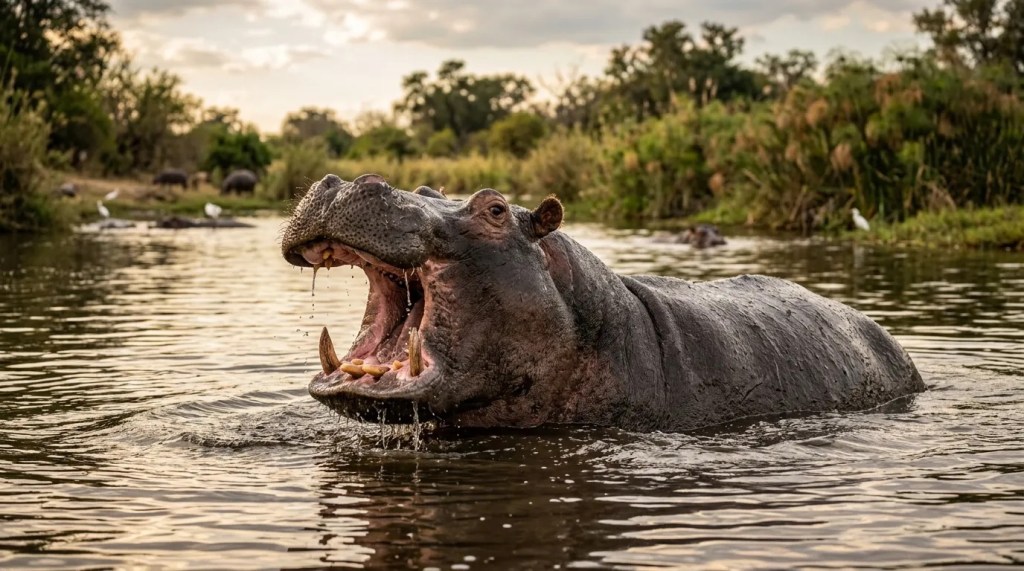
When people think of dangerous animals, they often imagine lions or crocodiles—but the real heavyweight contender is something far less expected: the Common Hippopotamus.
Despite looking slow, bulky, and almost “cartoonish,” hippos are responsible for more human fatalities in Africa than many large predators. Their power, speed, and aggression make them one of the most dangerous land mammals on Earth.
What is a hippopotamus?
The Common Hippopotamus is a large semi-aquatic mammal found in sub-Saharan Africa. It spends most of the day in rivers and lakes to stay cool, then comes onto land at night to graze.
Key traits:
Massive body with short legs Nearly hairless skin Eyes, ears, and nostrils positioned on top of the head (perfect for water life) Extremely territorial in water
Why are hippos so dangerous?
Even though they eat grass, hippos are highly aggressive when threatened—especially in water.
1. Extreme territorial behavior
Hippos fiercely defend their stretch of river or lake. Boats or humans accidentally entering their space can trigger aggressive reactions.
2. Surprising speed
On land, hippos can run up to 30 km/h (19 mph)—much faster than a human can sprint.
3. Powerful bite force
Their jaws can open nearly 150 degrees, and their teeth are strong enough to cause serious damage in a defensive encounter.
4. Water dominance
Hippos are far more agile underwater than they look. They can walk along the riverbed and move quickly in submerged environments.
Night-time grazers
At night, hippos leave the water to feed:
They travel several kilometers in search of grass They can eat 30–40 kg of vegetation per night They follow the same paths repeatedly, creating “hippo trails” through grasslands
Even though they eat plants, their size requires a huge amount of food.
Social structure
Hippos live in groups called pods or bloats, usually led by a dominant male.
Groups can range from 10 to 100 individuals Females and young stay closer together Males may become aggressive to maintain territory
Life in water
Hippos are built for aquatic life:
They can hold their breath for up to 5 minutes underwater They sleep submerged, surfacing automatically to breathe Their skin secretes a reddish oily substance that acts like a natural sunscreen and antibacterial layer
Myths vs reality
Myth: Hippos are slow and peaceful
Reality: They are highly territorial and extremely quick when provoked.
Myth: They are harmless herbivores
Reality: Their diet is plant-based, but their behavior is unpredictable and defensive.
Myth: Crocodiles are more dangerous in rivers
Reality: In many African regions, hippos cause more human fatalities than crocodiles.
Why hippos matter in nature
Even though they are dangerous, hippos play an important ecological role:
They help shape river ecosystems Their movement spreads nutrients between land and water Their grazing influences grassland growth patterns
Native to Africa Spend most of the day submerged Extremely territorial in water One of the most dangerous mammals on Earth Can weigh up to 1,500–3,200 kg
Final thought
The hippopotamus is a perfect example of nature’s contrast: a calm-looking giant that hides incredible strength and aggression beneath the surface. It reminds us that in the wild, appearances can be very misleading.
 ☄️WELCOME TO FACENOTEE.COM🕳️👍🏿
Leave a comment