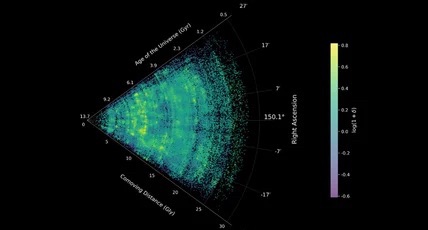
Astronomers are increasingly using the James Webb Space Telescope to refine our understanding of the “cosmic web” — the vast, thread-like structure of matter that connects galaxies across the universe.
What the “cosmic web” is
The cosmic web is the large-scale structure of the universe:
Galaxies are not randomly scattered They sit along massive filaments of dark matter and gas These filaments connect into a network, with huge empty voids in between
Think of it like a 3D spiderweb where:
knots = galaxy clusters threads = filaments of dark matter + gas empty spaces = cosmic voids
What Webb is improving
The James Webb Space Telescope doesn’t directly “see” dark matter, but it helps map the cosmic web more accurately by:
Seeing extremely distant galaxies (some from just a few hundred million years after the Big Bang) Tracing how galaxies are arranged in filaments Measuring star formation in early structures Improving redshift data (distance + expansion history of galaxies)
Because Webb sees in infrared, it can detect faint, redshifted light that older telescopes like Hubble missed — filling in missing “nodes” of the cosmic map.
By improving the cosmic web map, astronomers can:
Understand how galaxies first formed and clustered Test models of dark matter distribution Study how the universe evolved from a smooth early state into today’s structure Refine simulations of large-scale cosmic evolution
In short, Webb is helping turn a rough sketch of the universe’s structure into a much more detailed 3D map — showing how everything from small galaxies to massive clusters is connected across billions of light-years.
 ☄️WELCOME TO FACENOTEE.COM🕳️👍🏿
Leave a comment