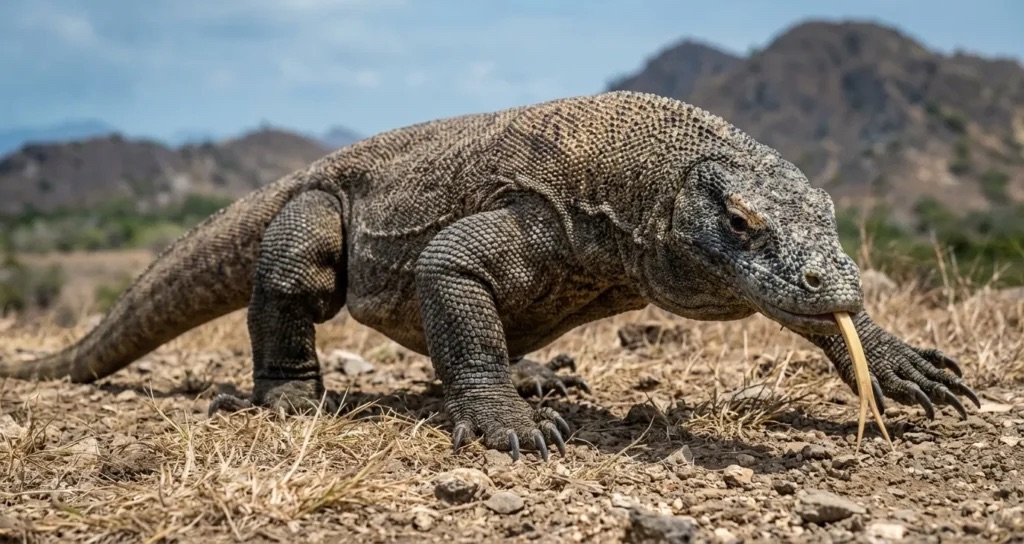
If an alligator and a dinosaur had a baby, it might be the Komodo dragon. This is the animal with the tongue that darts around like an anteater’s to help him smell things.
Komodo Dragon – The Largest Living Lizard
Komodo Dragon is the largest living lizard on Earth and one of the most powerful predators among reptiles. Found only in a few Indonesian islands, it is often described as a “living dragon” because of its size, strength, and hunting ability.
What Is a Komodo Dragon?
The Komodo dragon is a giant monitor lizard that can grow over 3 meters (10 feet) long and weigh more than 70–90 kg (150–200 lbs), sometimes even more in rare cases.
It is an apex predator, meaning it has no natural enemies in its habitat.
Appearance
Komodo dragons have a very intimidating look:
Thick, muscular body Rough, armor-like skin Long, powerful tail used for balance and combat Sharp claws for digging and fighting Strong jaws filled with serrated teeth
Their forked tongue helps them “smell” prey from far away.
Where They Live
Komodo dragons are found only in Indonesia, mainly on:
Komodo Island Rinca Island Flores Island (some areas)
They live in dry forests, savannas, and coastal regions.
What Do They Eat?
Komodo dragons are carnivores and eat:
Deer Wild boar Water buffalo (rare but possible) Birds Smaller dragons Carrion (dead animals)
They are opportunistic hunters and scavengers.
Hunting Strategy
Komodo dragons are powerful ambush predators:
They stalk or wait near trails They bite their prey with sharp teeth Their bite injects toxic saliva containing bacteria and venom-like compounds The prey weakens over time and is tracked using scent
They rely on patience rather than speed.
Behavior
Komodo dragons are:
Solitary animals Strong but slow runners Excellent swimmers when needed Very territorial
Younger dragons often climb trees to avoid being eaten by larger ones.
Reproduction
Females can reproduce through mating or rare parthenogenesis (without males) They lay eggs in burrows or nests Young dragons are vulnerable and live in trees for safety
Interesting Facts
They can eat up to 80% of their body weight in one meal They have a strong sense of smell using their tongue They can sprint short distances surprisingly fast Their bite can cause serious infection in prey They are considered living relics from ancient times
Conservation Status
Komodo dragons are classified as vulnerable due to:
Habitat loss Human activity Limited geographic range
They are protected in Komodo National Park.
The Komodo dragon is a powerful reminder of nature’s raw strength and ancient design. It dominates its island world not through speed or intelligence alone, but through patience, power, and evolutionary perfection.
 ☄️WELCOME TO FACENOTEE.COM🕳️👍🏿
Leave a comment