|
Getting your Trinity Audio player ready…
|
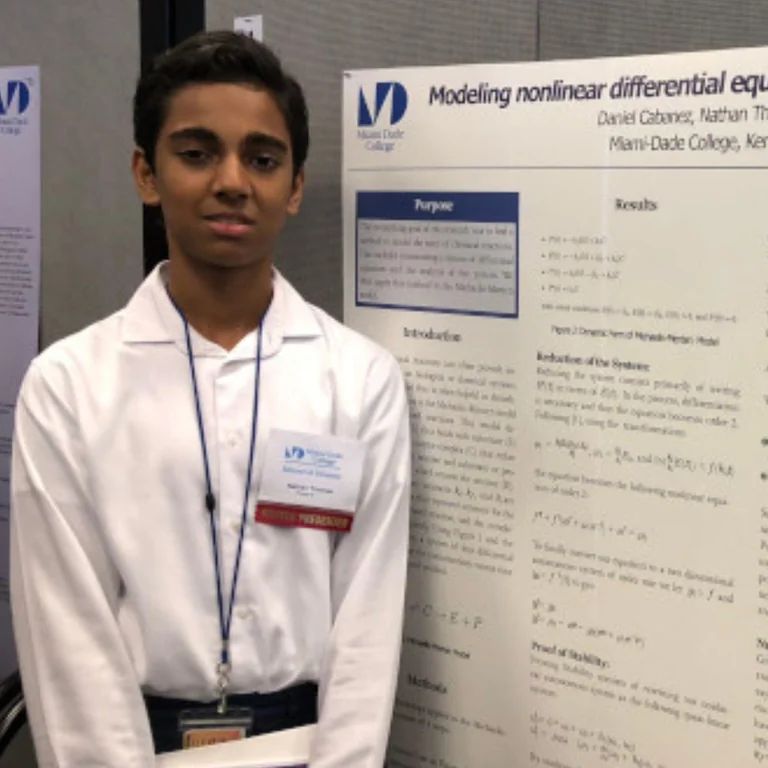
At an age when many young people are only beginning their university journey, Nathan Thomas had already achieved something extraordinarily rare: he had become a college professor.
Thomas, an American engineering prodigy, made history after Guinness World Records recognized him as the youngest professor (male). He was just 18 years and 346 days old when his record was verified. His achievement attracted international attention because it required him to reach an advanced level of education and professional responsibility years earlier than most people.
His story is particularly remarkable because becoming a professor normally requires years of university education, professional development, research and teaching experience. Thomas, however, accelerated his education and reached the classroom while still a teenager.

A Remarkable Academic Journey
Thomas’s achievement did not happen overnight. Long before he stood in front of college students as an instructor, he had already demonstrated an exceptional interest in engineering and technology.
By the time he reached 18, Thomas had earned both a bachelor’s degree and a master’s degree in electrical engineering with honours, according to reports about his record. That academic background placed him far ahead of the traditional educational timeline for someone his age.
His academic progress allowed him to move into higher education at an unusually young age. Rather than simply being a student sitting in a lecture hall, Thomas eventually found himself on the other side of the classroom, teaching students who were often considerably older than him.
In August 2023, he began teaching at Miami Dade College in Florida, where he taught a course known as C for Engineers. The course focuses on programming and engineering-related applications, giving Thomas an opportunity to apply his technical education in a teaching environment.
Breaking a Centuries-Old Record
One of the most fascinating aspects of Thomas’s achievement is the history behind the record.
Before Thomas, the record for the youngest professor was associated with Colin Maclaurin, the Scottish mathematician and student of Sir Isaac Newton. Maclaurin became a professor in the early eighteenth century and held the distinction for more than three centuries.
Thomas’s achievement therefore did not simply represent another young academic entering a university. It became part of a remarkable historical chain stretching back hundreds of years.
The record is also an example of how dramatically educational opportunities have changed. Maclaurin lived in an era when university education was available to only a small proportion of society. Thomas, by contrast, grew up in an era of advanced technology, accelerated learning programs and much broader access to educational resources.
The Alia Sabur Connection
There is an important distinction when describing Thomas as the world’s youngest professor.
In 2008, Alia Sabur, an American mathematics and science prodigy, became the youngest university professor at the age of 18 years and 362 days. She was appointed to the faculty of Konkuk University in Seoul, South Korea, in the Department of Advanced Technology Fusion.
Sabur had also followed an extraordinary academic path. She entered college at just 10 years old, earned a bachelor’s degree in applied mathematics at 14 and completed a doctorate in materials science and engineering by 18. She subsequently became a full-time faculty member at Konkuk University.
Thomas was younger than Sabur when he achieved his Guinness-recognized record, making his accomplishment especially notable. Reports have described him as being 16 days younger than Sabur was when she set her record.
Because Guinness has separate categories, Thomas’s official record is described as youngest professor (male). This distinction helps explain why headlines sometimes use slightly different descriptions of his achievement.
Teaching Students at 18
Being academically gifted is one thing. Standing before a classroom and teaching other students is something else entirely.
Thomas’s role at Miami Dade College meant that his responsibilities extended beyond simply possessing advanced qualifications. He had to communicate technical concepts clearly enough for students to understand them.
His course, C for Engineers, placed him in a position where knowledge of programming and electrical engineering had to be translated into practical lessons.
The unusual age difference between Thomas and some of his students also made the appointment particularly striking.
At 18, he was close in age to some college freshmen, yet he was occupying a teaching position. Instead of being the student asking questions, he was helping others understand a demanding technical subject.
That situation demonstrates that academic achievement and age do not always follow the traditional timeline.
What Makes His Story So Unusual?
Thomas’s story highlights the possibilities created by accelerated education.
Most students spend their childhood and teenage years progressing through primary and secondary education before entering university. They then spend several years completing undergraduate studies before considering graduate school or an academic career.
Thomas compressed much of that process.
By completing undergraduate and graduate-level engineering education before turning 19, he demonstrated an ability to move through academic programs at an exceptional speed.
However, his story is not simply about being intelligent. Advanced academic achievement also requires discipline, persistence and the ability to work with difficult material.
Engineering, particularly electrical engineering, involves mathematics, programming, physics and problem-solving. A student pursuing advanced qualifications in the field must be able to handle demanding coursework and complex technical concepts.
Thomas’s accomplishments therefore represent a combination of academic ability and an unusually accelerated educational pathway.
A New Chapter in His Education
Interestingly, becoming a professor did not mark the end of Thomas’s academic ambitions.
After his engineering achievements, he turned his attention toward another field: law.
Reports indicate that Thomas subsequently enrolled at the University of Miami School of Law to pursue a Juris Doctor degree.
The decision illustrates that his interests extend beyond engineering and computer science.
Moving from engineering into law could eventually give Thomas an unusual combination of technical and legal knowledge. As technology continues to influence areas such as artificial intelligence, cybersecurity, intellectual property and digital regulation, people with backgrounds spanning technology and law can contribute to increasingly complex discussions.
For Thomas, the next stage of his education could therefore be as interesting as the achievement that first brought him worldwide attention.
An Inspiration for Young People
Thomas’s record is also likely to inspire young students who have ambitions that do not fit traditional educational timelines.
His story demonstrates that exceptional students can sometimes progress much faster than conventional expectations suggest.
At the same time, his achievement should not be interpreted as meaning that every young person needs to accelerate their education. Students have different abilities, interests and circumstances, and academic success cannot be measured only by how early someone earns a degree or obtains a professional title.
What makes Thomas’s story remarkable is that he pursued an educational path that suited his particular abilities and interests.
His record also serves as a reminder that age alone does not determine someone’s capacity to learn, contribute or teach.
The Bigger Meaning of the Record
The significance of Thomas’s achievement goes beyond the Guinness World Records title.
His story raises interesting questions about the future of education. As technology makes information more accessible and educational programs become increasingly flexible, talented students may have more opportunities to progress according to their abilities rather than simply their age.
Universities are also experimenting with different approaches to education, including online learning, accelerated programs, dual-enrollment opportunities and competency-based education.
Thomas represents an extreme example of what can happen when academic acceleration, talent and opportunity come together.
His journey from an exceptionally young engineering student to a college professor shows how dramatically an individual’s educational path can differ from the traditional model.
Looking Ahead
At only 18 when he achieved his record, Thomas had already accomplished what many people spend decades working toward.
His recognition by Guinness World Records placed his name alongside other remarkable academic prodigies, including Alia Sabur and the much earlier record-holder Colin Maclaurin.
Yet perhaps the most interesting part of his story is what comes next.
With engineering qualifications behind him and legal studies ahead, Thomas has already demonstrated that his ambitions extend beyond a single academic field.
His record is a remarkable milestone, but it may ultimately become only one chapter in a much longer career.
For now, his achievement stands as an extraordinary example of accelerated academic success: an 18-year-old who moved from being a student to teaching college students and earned a place in Guinness World Records in the process.
Nathan Thomas’s story shows that while age can define a stage of life, it does not necessarily define the limits of what a determined and exceptionally talented young person can accomplish.

