|
Getting your Trinity Audio player ready…
|
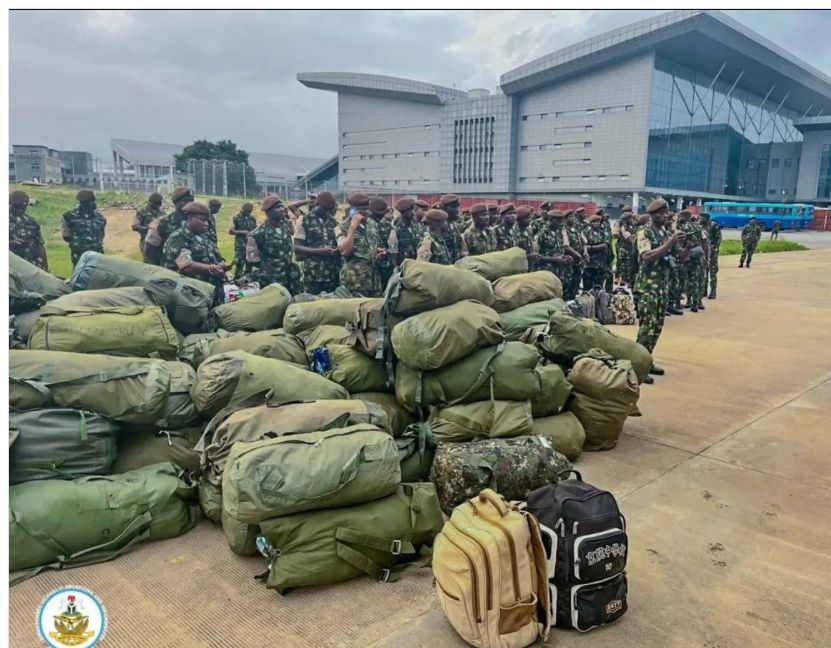
Nigeria has reaffirmed its commitment to regional peace and security with the deployment of 86 military personnel to the Economic Community of West African States (ECOWAS) Stabilisation Support Mission in Guinea-Bissau (ESSMGB). The deployment underscores the country’s longstanding leadership role in peacekeeping operations across West Africa and reflects ECOWAS’ determination to maintain stability in one of the region’s politically fragile nations.
The contingent, comprising officers and soldiers of the Nigerian Army, departed after completing the necessary training, medical screening, and operational preparations. The troops are expected to work alongside personnel from other ECOWAS member states, including Ghana and Senegal, under the regional peace support mission established to preserve constitutional order and prevent political instability in Guinea-Bissau.

The latest deployment comes at a critical time as ECOWAS continues to strengthen its peacekeeping and conflict prevention mechanisms amid growing security challenges in West Africa. The regional bloc has been confronted with military coups, terrorism, political instability, and cross-border criminal activities that threaten democratic governance and economic development.
Guinea-Bissau has experienced decades of political turbulence since gaining independence. The country has witnessed multiple coups, attempted coups, military interventions, and prolonged political disputes that have hindered democratic consolidation. Although the security situation has improved in recent years, ECOWAS has maintained a stabilisation mission to support national authorities and ensure a peaceful political environment.
Nigeria has traditionally played a leading role in ECOWAS peace operations. From the days of the ECOWAS Monitoring Group (ECOMOG) missions in Liberia and Sierra Leone to more recent regional peace support operations, Nigerian troops have consistently formed the backbone of many multinational deployments. Their professionalism and operational experience have earned the country recognition as one of Africa’s foremost contributors to regional peacekeeping efforts.
Military authorities described the new deployment as part of Nigeria’s responsibility under the ECOWAS framework to promote peace, democracy, and stability within the West African sub-region. They noted that the selected personnel underwent rigorous pre-deployment exercises designed to prepare them for multinational operations, including civil-military cooperation, rules of engagement, humanitarian protection, and international peacekeeping standards.
The troops will be tasked with supporting the security architecture in Guinea-Bissau through patrol operations, protection of strategic national institutions, intelligence gathering, confidence-building activities, and cooperation with local security agencies. They will also assist in creating a secure environment that enables democratic governance and socio-economic development.
ECOWAS has repeatedly stressed that the Stabilisation Support Mission is intended to complement, rather than replace, Guinea-Bissau’s national security institutions. The regional force works closely with the country’s government while respecting its sovereignty and supporting local capacity-building initiatives.
The deployment also reflects the increasing emphasis placed on operational readiness by ECOWAS. In recent months, the regional organisation has intensified inspections and evaluations of troop-contributing countries to ensure that personnel, equipment, and logistics meet international standards before deployment. These inspections form part of broader reforms aimed at improving the effectiveness of ECOWAS peace support operations.
Security analysts believe Nigeria’s participation sends a strong message regarding its continued commitment to regional cooperation despite facing numerous domestic security challenges, including insurgency, banditry, kidnapping, and communal conflicts. While the Nigerian Armed Forces remain heavily engaged within the country, the government has maintained that contributing to regional stability ultimately strengthens Nigeria’s own national security interests.
Nigeria’s strategic importance within ECOWAS extends beyond troop contributions. The country has often provided logistical support, military planning expertise, and political leadership during regional crises. Successive Nigerian governments have argued that instability in neighbouring countries can easily spill across borders through refugee movements, illegal arms trafficking, organised crime, and terrorism.
The ECOWAS Stabilisation Support Mission in Guinea-Bissau consists of military contingents from several member states operating under a unified command structure. The multinational force is responsible for maintaining security around key government institutions, supporting constitutional governance, and assisting local authorities in preserving peace.
Earlier this year, ECOWAS inspection teams visited the mission headquarters and various national contingents, including Nigerian personnel, to assess operational effectiveness, logistics, troop welfare, and mission sustainability. The inspection highlighted the professionalism and dedication of participating forces while identifying areas for continued improvement.
The Nigerian contingent joining the mission is expected to rotate with existing personnel after completing its assigned operational tour. Such rotational deployments ensure continuity of operations while allowing soldiers adequate rest and retraining upon returning home.
Experts note that modern peacekeeping missions require far more than traditional military capabilities. Peacekeepers are increasingly expected to engage local communities, support humanitarian initiatives, protect civilians, and cooperate with international organisations working in conflict-prone environments. As a result, Nigerian troops undergo specialised training covering human rights, international humanitarian law, conflict resolution, and community engagement before deployment.
The deployment also aligns with ECOWAS’ broader vision of strengthening the ECOWAS Standby Force, a regional security mechanism designed to respond rapidly to crises across member states. Recent operational readiness inspections and force verification exercises demonstrate the bloc’s determination to maintain highly trained and deployable units capable of responding to emerging threats throughout West Africa.
Observers believe sustained international and regional support remains essential for Guinea-Bissau’s democratic development. While the country has made progress in recent years, political tensions and institutional weaknesses continue to require close monitoring and preventive engagement.
For Nigeria, the latest deployment reinforces decades of leadership in African peacekeeping. Nigerian troops have served under the United Nations, African Union, and ECOWAS in numerous conflict zones, earning a reputation for professionalism and resilience despite challenging operational conditions.
As the 86-member contingent begins its mission, expectations remain high that the deployment will contribute to preserving peace, strengthening democratic institutions, and supporting long-term stability in Guinea-Bissau. The mission also reflects ECOWAS’ continuing commitment to collective security, demonstrating that regional cooperation remains central to addressing the complex political and security challenges confronting West Africa in the years ahead.

