|
Getting your Trinity Audio player ready…
|
Every day in the United States, an estimated 50,000 old mattresses are thrown away. While many people see a worn-out mattress as nothing more than bulky household waste, the reality is quite different. Hidden inside most traditional mattresses is a valuable material that is essential to modern manufacturing—steel. In fact, more than 80 percent of the recyclable content found in many innerspring mattresses is steel, making them an important source of reusable raw materials.
The staggering number of mattresses discarded daily has raised concerns among environmentalists, waste management experts, and recycling companies. Millions of mattresses end up in landfills every year, occupying enormous amounts of space despite containing materials that can be recovered and reused. As awareness of sustainable waste management grows, mattress recycling is becoming an increasingly important part of the circular economy.

A Growing Waste Problem
Americans replace their mattresses more frequently than ever before. Industry experts estimate that the average mattress lasts between seven and ten years, although this depends on the quality of the mattress and how well it is maintained. Population growth, changing lifestyles, and increasing consumer spending have all contributed to higher mattress disposal rates.
With around 50,000 mattresses discarded every day, that amounts to more than 18 million mattresses every year. Because mattresses are large and difficult to compress, they quickly consume valuable landfill space. Unlike ordinary household waste, mattresses can become tangled in landfill equipment, increasing maintenance costs and slowing waste processing operations.
Many municipalities spend millions of dollars annually collecting and disposing of illegally dumped mattresses from roadsides, vacant lots, parks, and public spaces.
What’s Inside a Mattress?
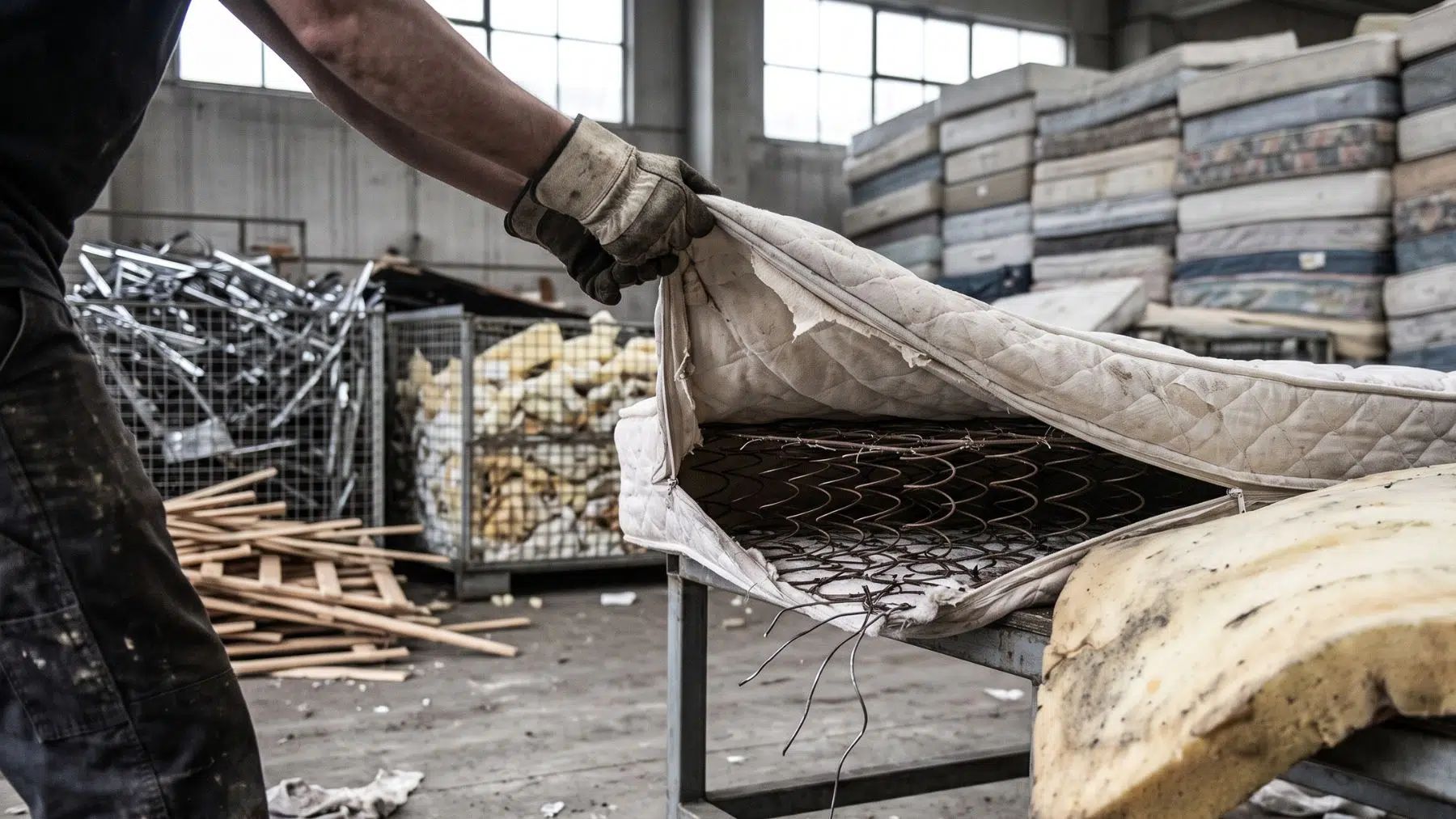
Although mattresses appear simple from the outside, they are actually made from a combination of different materials. Traditional innerspring mattresses typically contain:
- Steel coils and springs
- Foam padding
- Cotton
- Polyester fibers
- Wood frames
- Fabric covers
Among these components, steel represents the most valuable recyclable material. In many innerspring mattresses, steel accounts for more than 80 percent of the recyclable content by value and plays a significant role in the recycling process.
The steel coils provide structural support, durability, and comfort. Because steel is one of the world’s most recyclable materials, these springs can be melted down and transformed into entirely new products.
Why Steel Matters
Steel can be recycled repeatedly without losing its strength or quality. Unlike some plastics that degrade after multiple recycling cycles, recycled steel performs just as well as newly produced steel.
When mattresses are recycled, the steel springs are removed, cleaned, compressed into bundles, and shipped to steel mills. There, they are melted and used to manufacture products such as:
- Construction beams
- Reinforcing bars
- Household appliances
- Automotive parts
- Nails
- Wire products
- New steel coils
Recycling steel also requires significantly less energy than producing steel from raw iron ore. This helps reduce greenhouse gas emissions while conserving natural resources.
Beyond Steel: Other Recyclable Materials
Although steel is the primary recyclable component, other mattress materials can also be reused.
Foam from mattresses is often shredded and used in carpet underlay, pet bedding, gym mats, furniture cushions, and insulation products.
Wood recovered from mattress frames can become landscaping mulch, biomass fuel, or wood chips used in manufacturing.
Cotton and textile fibers may be processed into industrial wiping cloths, insulation materials, or padding for various products.
Some mattress recycling facilities report recovering up to 90 percent of a mattress’s materials, greatly reducing the amount sent to landfills.
Environmental Benefits
Mattress recycling offers several environmental advantages.
First, it reduces landfill waste. Because mattresses occupy large volumes, diverting them from landfills extends landfill lifespan and reduces disposal costs.
Second, recycling conserves natural resources. Recovering steel means less mining for iron ore and reduced energy consumption during steel production.
Third, recycling lowers carbon emissions associated with manufacturing new materials.
Finally, recycling helps reduce illegal dumping, which can damage neighborhoods and create health hazards.
Economic Opportunities
The mattress recycling industry also creates jobs.
Workers are needed to collect discarded mattresses, transport them, dismantle materials, separate recyclable components, process steel, and manufacture recycled products.
Small businesses specializing in mattress recycling have emerged across several states, supporting local economies while reducing environmental impacts.
Recovered steel has substantial market value, making mattress recycling financially worthwhile when efficient collection systems are in place.
Challenges to Recycling
Despite its benefits, mattress recycling faces several challenges.
One of the biggest obstacles is transportation. Mattresses are bulky and expensive to move. A truck can carry far fewer mattresses than other forms of waste, increasing transportation costs.
Contamination is another issue. Mattresses damaged by water, mold, pests, or hazardous materials may be unsuitable for recycling.
Labor costs are also significant because dismantling mattresses often requires manual work to separate the various materials safely.
Additionally, public awareness remains relatively low. Many consumers simply leave old mattresses on the curb without realizing they could be recycled.
Government Initiatives
Some U.S. states have introduced mattress recycling programs designed to reduce landfill waste.
Extended Producer Responsibility (EPR) laws require manufacturers to help fund recycling systems for discarded mattresses. These programs create collection sites where residents can drop off used mattresses for proper recycling.
Such initiatives encourage manufacturers to design products that are easier to recycle while reducing the financial burden on local governments.
The Circular Economy
Mattress recycling is an excellent example of the circular economy—a system where products and materials remain in use for as long as possible instead of becoming waste.
Rather than extracting new raw materials, recycling allows valuable resources like steel to remain in continuous circulation.
This approach reduces environmental damage, lowers manufacturing costs, and minimizes waste generation.
Consumer Responsibility
Consumers also play an important role in reducing mattress waste.
Instead of throwing mattresses into dumpsters or abandoning them illegally, individuals can:
- Donate gently used mattresses where permitted.
- Use local recycling facilities.
- Participate in municipal collection events.
- Check whether retailers offer old mattress take-back programs when delivering new ones.
Proper disposal helps ensure valuable materials are recovered instead of wasted.
Future Innovations
Researchers and manufacturers continue developing mattresses that are easier to recycle.
Some companies are designing mattresses with modular components that can be quickly separated at recycling facilities. Others are experimenting with biodegradable materials, recyclable foams, and adhesives that simplify disassembly.
Automation is also improving recycling efficiency. New machines can separate steel springs from foam and textiles more quickly than manual labor alone, reducing processing costs.
As recycling technology advances, even higher percentages of mattress materials may become recoverable.
A Valuable Resource Hidden in Plain Sight
Many people never think about what happens to an old mattress after it leaves their home. Yet every discarded mattress contains valuable resources that can support manufacturing, reduce waste, and protect the environment.
Steel, which makes up more than 80 percent of the recyclable value inside many mattresses, can be reused indefinitely. Combined with recyclable foam, wood, textiles, and fibers, a single mattress contains far more reusable material than most people realize.
With approximately 50,000 mattresses discarded each day in the United States, improving recycling systems could prevent millions of mattresses from entering landfills every year. Increased public awareness, better recycling infrastructure, and continued innovation in mattress design will all play essential roles in creating a more sustainable future.
Rather than viewing an old mattress as trash, experts increasingly see it as a collection of valuable materials waiting to be recovered and transformed into new products. As recycling efforts continue to expand, the steel hidden inside millions of discarded mattresses may become one of the industry’s greatest untapped resources, helping build a cleaner environment while supporting a more efficient and sustainable economy.

