|
Getting your Trinity Audio player ready…
|

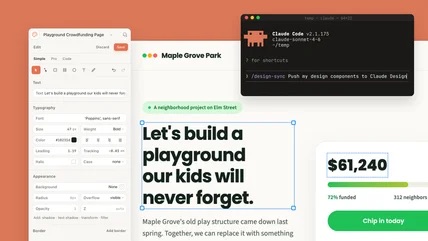
Anthropic has been steadily tightening the connection between its design assistant tools and its coding agent workflows, and the latest update focuses on making both systems work together more smoothly inside development environments powered by its models.
At the center of this improvement is better integration between design intent (what you want to build visually or structurally) and code execution (how it actually gets built in software). Instead of treating these as separate steps, Anthropic is trying to make them feel like a single continuous workflow.
What the “design assistant” actually does
Anthropic’s design assistant is meant to help users translate ideas into structured outputs. That can include:
- UI layouts and component structures
- App flow descriptions
- Interface logic and user experience planning
- High-level system design suggestions
It acts like a bridge between brainstorming and implementation.
How the coding agent fits in
The coding agent (built around models like Anthropic’s Claude family) is focused on:
- Writing and refactoring code
- Debugging issues
- Building full project structures
- Interacting with repositories and tools
In earlier versions, these two systems often felt partially separate—you’d design something conceptually, then manually translate it into code instructions.
What has changed in the integration
The new improvement is about tight coupling between design outputs and coding actions.
Now, instead of just producing static design suggestions, the assistant can:
- Turn UI designs directly into usable code components
- Maintain consistency between design decisions and implementation
- Pass structured design context into the coding agent automatically
- Reduce the need for repeated clarification between tools
For example, if a user describes a dashboard layout, the design assistant can generate a structured plan, and the coding agent can immediately use that plan to build front-end components.
Why this matters for developers
This update is aimed at solving one of the biggest inefficiencies in software development: translation loss between design and code.
Traditionally, teams go through multiple steps:
- Product idea or UI concept
- Design mockups (Figma-style thinking)
- Developer interpretation
- Implementation in code
- Revision loop when things don’t match intent
By connecting the design assistant more tightly to the coding agent, Anthropic is trying to compress this into:
Idea → structured design → working code
This reduces friction, especially for:
- Rapid prototyping
- Startup MVP development
- Internal tools and dashboards
- AI-assisted software engineering workflows
Better context awareness between systems
Another key upgrade is shared context memory between the two systems. The coding agent now better understands:
- Component hierarchy from the design stage
- Layout constraints and UI structure
- Naming conventions defined during design planning
This helps reduce “hallucinated structure,” where code output doesn’t match the original design intent.
Faster iteration loops
One of the biggest practical improvements is iteration speed.
Developers can now:
- Adjust design prompts
- Instantly regenerate updated UI structure
- Have the coding agent recompile or patch code accordingly
This makes prototyping feel more dynamic, similar to editing a live system rather than rebuilding from scratch.
How it compares to earlier AI coding tools
Most AI coding assistants historically focused only on:
- Autocomplete
- Code explanation
- Bug fixing
But Anthropic’s approach is more workflow-oriented, combining:
- Product thinking (design assistant)
- Implementation (coding agent)
- Continuous feedback loop
This is closer to an end-to-end “AI software teammate” than a simple code generator.
Limitations still remain
Even with tighter integration, there are still challenges:
- Complex UI systems still require human architectural decisions
- AI-generated designs may not always follow real-world UX best practices
- Large-scale production systems still need manual review and optimization
- Edge cases in code behavior still require debugging by developers
So the system improves productivity, but it doesn’t remove engineering responsibility.
Bottom line
Anthropic’s latest update is less about adding new features and more about making design and coding feel like one unified process. By improving how the design assistant feeds into the coding agent, the company is pushing toward a future where developers can move from idea to working software with fewer translation steps and less friction in between.