
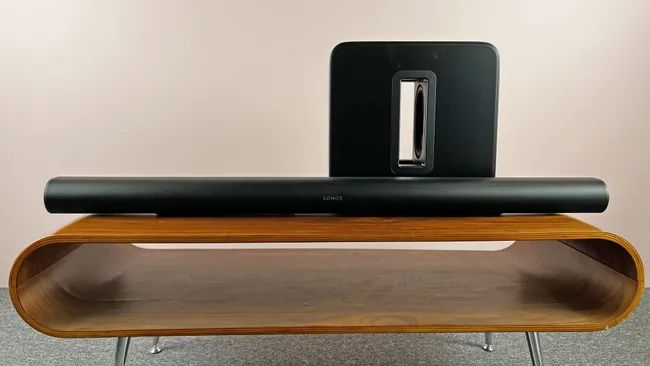
Soundbars have been the answer – they can face directly towards you, include larger speaker drivers and a deeper frame to accommodate them, have a heavy structure to absorb unwanted vibrations better, and many come with a separate subwoofer so that there’s no trade-off with having a big hefty bass driver. Good bass is supposed to be directionless, so it can just go somewhere else; easy.
Some of the best TVs for sound have something a lot like a soundbar built into their structure, and they don’t worry about being taller and thicker as a result. Same principle, they’re just cutting out having a separate unit.
The best Dolby Atmos soundbars will also take the opportunity to include speakers at different angles, and use sound processing to create a positional feeling to elements in the audio, using a combination of having dedicated width or height speakers, and ‘psychoacoustic’ tricks, where tinkering with the timing of a sound element, for example, can change how we perceive hearing it. The idea is to make the sound feel like it’s coming from more directions than just a small bar in front of you.
For example, a soundbar might only be able to house a driver that’s two inches tall, but by using a racetrack driver that’s three inches wide, rather than a circular one, then you’ve got 50% more surface area. (Not all of this is useful surface area, but you get the idea.)
Soundbars are still small in size, of course, and some get around the limited physical volume by using multiple identical speakers, for example, which is another way to move more air at once in a particular part of the frequency range. They also often use oval ‘racetrack’ drivers instead of circular ones, again as a compromise between being able to move more air but not to be too tall.
But we’re still talking drivers that are three inches in size, and not even three inches and circular. Capable, but not the hardcore stuff.
You must be logged in to post a comment.